
Tell MPCA by JUNE 22 – Require U.S. Steel (Nippon) Minntac to Cut Toxic Mercury Air Emissions!
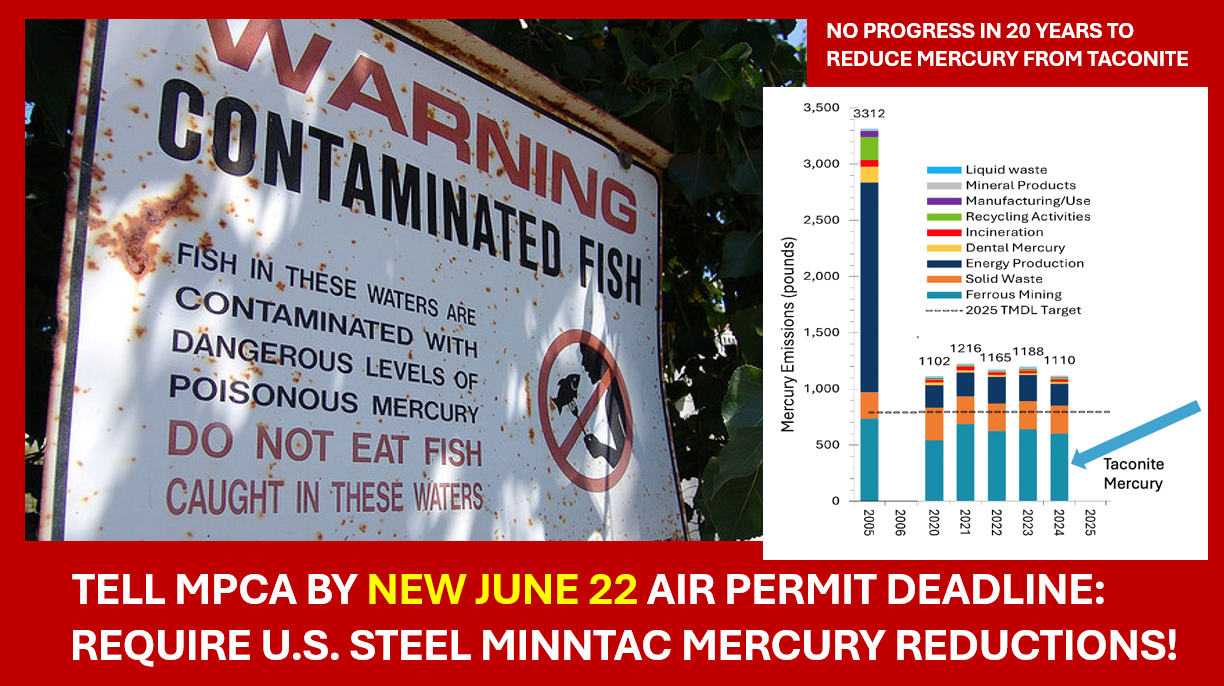
Minnesota’s Statewide Mercury TMDL and Mercury Reduction Rule require Minnesota’s taconite plants–like every other mercury emissions source in Minnesota–to reduce mercury by 72% as compared to their 2008 or 2010 “baseline.” U.S. Steel (Nippon) Minntac and other taconite plants have failed to do so. U.S. Steel has stated that Minntac’s baseline mercury emissions are 199 pounds of mercury per year. That is more than one-sixth of the mercury emitted by all the Minnesota sources of mercury emissions (energy, waste, incinerators, manufacturing, dental mercury).
The Minnesota Pollution Control Agency (MPCA) has the legal authority to require Minntac to reduce mercury air emissions. MPCA has told both U.S. Steel and the U.S. Environmental Protection Agency (EPA) that Minntac could use technically available and cost-effective mercury controls to reduce mercury by 72% or even 85%.
But, MPCA’s current Draft Air Emissions Permit for Minntac sets no State requirements for mercury reduction! The Draft Permit admits that EPA mercury limits are stalled out by a Trump executive order until at least 2029, if they are not undone by then. But the MPCA has proposed no State requirements to reduce Minntac mercury emissions to comply with State law or protect Minnesota fish, wildlife, or humans from toxic mercury.
Community leaders secured an extension, and the NEW deadline for us to tell MPCA to require Minntac to reduce mercury air emissions by at least 72%, as required by state law, is June 22, 2026.
Why is it important that you Comment and Tell MPCA to Require Minntac Mercury Reductions?
The MPCA talked tough when the U.S. Environmental Protection Agency (EPA) had its back. In January 2023, the MPCA told U.S. Steel that MPCA had determined there were “three technically achievable methods to achieve a 72% reduction” of Minntac mercury emissions by January 1, 2025.
The MPCA then asked the EPA in June 2023 to set “more stringent mercury limits” since activated carbon injection controls were available “to achieve up to an 85% reduction in mercury emissions.” Times have changed, and the EPA is no longer working to reduce toxic mercury.
- Now that MPCA must act on its own, MPCA seems afraid to enforce Minnesota’s requirements. MPCA’s draft permit has no requirements that Minntac reduce mercury by any amount, let alone by the 72% that is required by Minnesota’s Mercury TMDL and Mercury Reduction Rule.
- MPCA’s draft permit also fails to require that Minntac perform the kind of monitoring–mercury isotopic tracing–that would allow regulators and other scientists to determine how mercury from Minntac affects Minnesota’s food web and increases mercury contamination of fish.
Your comments are needed to convince MPCA to use its authority to reduce mercury air emissions!
How do I submit a Comment to Tell MPCA to Require Minntac Mercury Reduction?
- You can use the Draft Comment below to send your opinion directly to MPCA staff by 11:59 pm on June 22. If you can take a minute and personalize the draft Comment, whether by talking about your personal knowledge and experience or adding something from the Talking Points, it will strengthen the impact of your comments.
- You can also cut and paste from the draft Comment and Talking Points to submit a comment using the MPCA’s online Public Comment Form by 11:59 pm on June 22. The MPCA’s form allows you to upload a letter or attachments.
Talking Points to Help You Tell MPCA to Require Minntac Mercury Reduction and Monitoring to Detect how Minntac Mercury Air Emissions Affect Minnesota Waters!
- Mercury air emissions increase formation and bioaccumulation of toxic methylmercury in fish and other aquatic life, reducing fish reproduction and affecting neurological development of wildlife (e.g. loons, bats) and humans who eat fish or other aquatic life contaminated with methylmercury.
- In 2011, the Minnesota Department of Health (MDH) found that 10% of newborns in Minnesota’s Lake Superior Region had excessive methylmercury in their blood; high enough to reduce IQ. Developing brains of fetuses, infants, and children are 4 to 5 times more vulnerable to mercury than those of adults.
- Between 1990 and 2005, Minnesota’s mercury emissions were cut by 70%, primarily by phasing out products containing mercury. Taconite plants were an outlier even then; taconite emissions increased about 5% from 1990 to 2000.
- In 2007, Minnesota adopted and the EPA approved a Mercury Statewide Mercury Total Maximum Daily Load (TMDL) to ensure that fish would be safe for consumption. Minnesota’s Mercury TMDL set targets to reduce mercury emissions sector by sector to reach a limit of 789 pounds per year by 2025 (72%).
- In 2014, Minnesota adopted and the EPA approved a Mercury Reduction Rule. Minn. R. 7007.0502. That rule says that existing mercury emissions sources “must” prepare a mercury reduction plan that will reduce mercury emissions by 72% from their baseline by January 1, 2025, unless mercury reductions “are not technically achievable.”
- Since 2005, Minnesota sources of mercury other than taconite/ferrous mining have actually reduced emissions, as shown in the MPCA chart below. In June 2023, the MPCA told EPA that EPA’s proposed rules for taconite (the MACT mercury limit show below as “a”) were not stringent enough to comply with the 72% reduction specified in Minn. R. 7005.0502.
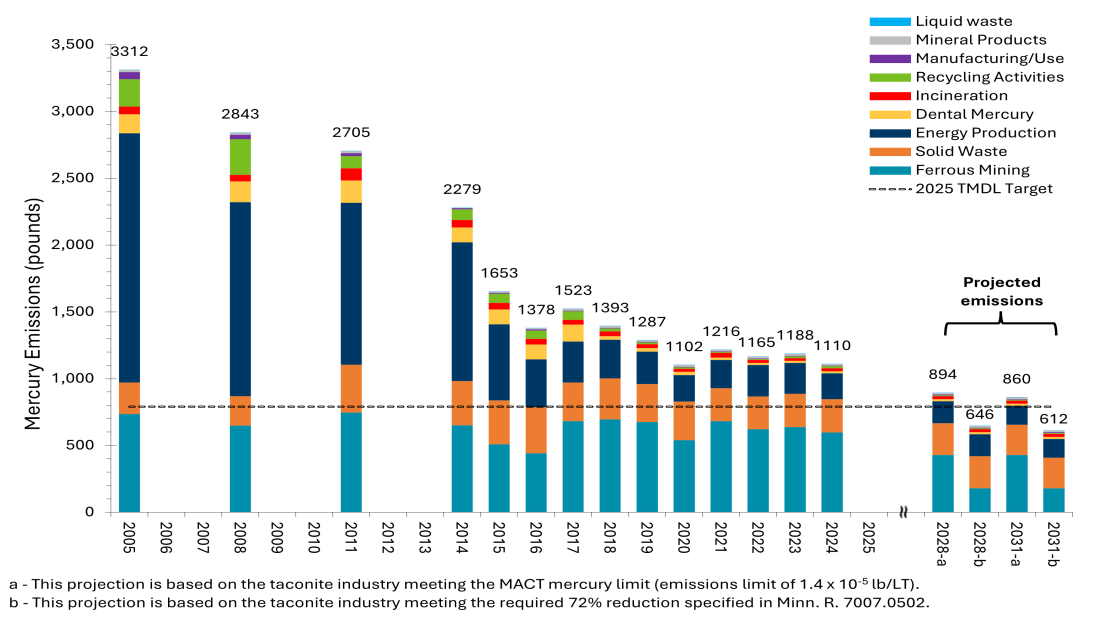
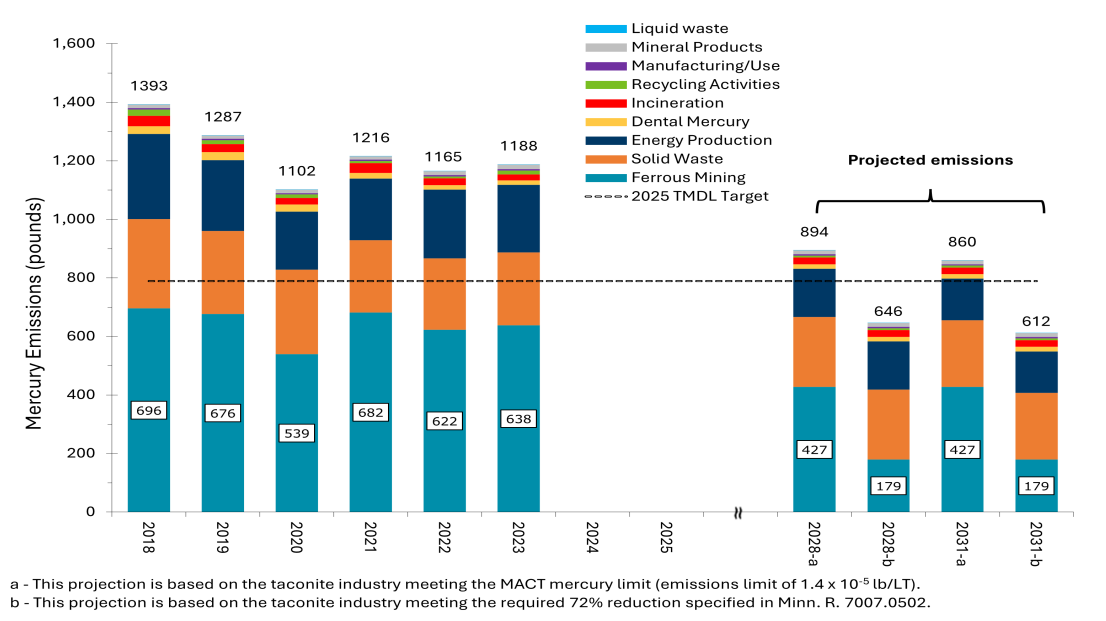
- In a recent meeting of the Statewide Mercury TMDL Oversight Committee, MPCA revealed that the taconite industry–at 638 pounds per year in 2024–now produces more than half of the total mercury emissions in Minnesota. A 72% reduction in mercury from taconite plants would result in Minnesota’s compliance with the State’s Mercury Reduction Rule, 7007.0502, as shown below.
- Waters downwind of Minntac mercury air emission and downstream of Minntac sulfate releases to water are impaired for mercury. Many fish sampled in the Pike River Flowage into Lake Vermillion and Crane Lake in recent years have levels of mercury above the MDH “do not eat” threshold.
- Experts, including tribal scientists, have told MPCA for years that isotopic mercury testing is needed to determine where mercury emitted from Minntac and other taconite plants is being deposited and how this mercury is affecting Minnesota water quality, fish, wildlife, and human health. MPCA has the authority to require this testing, but has not done so.
- MPCA’s draft Minntac Air Emissions Permit has no limits on mercury emissions and no mercury reduction requirements. The draft Permit requires no isotopic mercury monitoring to allow regulators, scientists, tribes, and the public to trace Minntac mercury air emissions and food-web bioaccumulation resulting from those mercury emissions.
- If the draft Permit required Minntac to reduce its emissions by 72% as compared to U.S. Steel’s admitted baseline (199 pounds per year), the amount of mercury emissions in Minnesota could be reduced by approximately 143 pounds per year.
Comment NOW to Tell MPCA to Reduce Minntac Mercury Emissions and Require Monitoring of Mercury Isotopes to Track Effects of Emissions.
You can use the Draft Comment below by 11:59 pm on June 22 to send your opinion directly to MPCA staff. Your comments will be strengthened if you add information about your experience or from the Talking Points to personalize your comments.
If you have trouble using this form or the MPCA comment link by June 22, please don’t give up!
Feel free to contact Sophia for help at: sophia@waterlegacy.org